Best Liquid Weed and Feed for St Augustine Grass
St. Augustine grass is famously sensitive to the wrong herbicides. A liquid weed and feed can work beautifully on thick, established southern turf — but only when the formula is built for it. This guide explains what to look for, which active ingredients are safe, and how to apply with confidence.
Why Liquid Weed and Feed Is Different for St. Augustine
St. Augustine is a warm-season grass with a coarse texture and a shallow root system. It spreads via runners and tolerates heat well, but its broad blades absorb herbicides differently than fine fescue or Bermuda. The biggest risk is chemical burn: a liquid product that is safe for Bermuda may yellow or kill St. Augustine if the 2,4-D concentration is too high or if it is applied during heat stress.
Extension guidance is clear: if you have St. Augustine or centipede grass, choose a product specifically labeled for these lawns. The 2,4-D content is the main variable — too much can injure the grass even as it kills the weeds [citation:10]. Liquid application has an advantage over granules in one key way: droplets stick to weed leaves rather than bouncing off and landing in the thatch. But that same efficiency means mixing accuracy matters even more.
What to Look For in a Liquid Weed and Feed
1. Grass-Safe Active Ingredients
Atrazine is one of the most reliable herbicides for St. Augustine and centipede grass. It works as both a pre-emergent and post-emergent, targeting broadleaf weeds like clover, henbit, and chickweed while suppressing early crabgrass. Southern Ag Atrazine is a top-tier concentrate for this purpose, though it contains no fertilizer — you will need a separate feeding program [citation:1]. Dicamba is another option for tough broadleaf weeds like creeping charlie, but it is less forgiving: over-application or hot-weather spraying can discolor St. Augustine, so spot-test first [citation:1].
2. Fertilizer Component (or Lack of It)
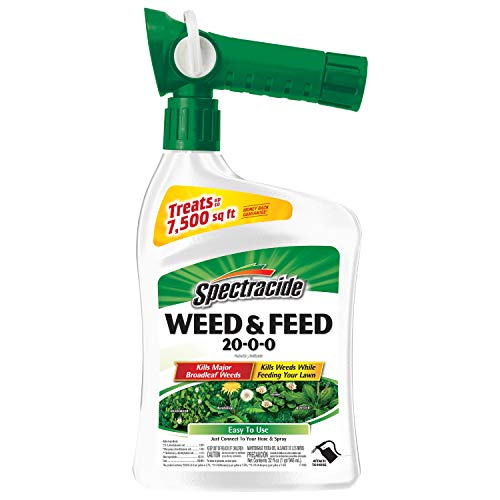
Many liquid “weed and feed” products are actually herbicide concentrates with little or no nitrogen. If your St. Augustine is thin or pale, you may need to pair the weed control with a separate liquid fertilizer. A true all-in-one liquid, like Bonide Liquid Weed & Feed 20-0-0, includes a hose-end sprayer and is labeled safe for St. Augustine, but its coverage per bottle is limited [citation:7]. Decide whether you want convenience or flexibility.
3. Application Method
Hose-end sprayers are the most popular delivery method for liquids, but they demand a steady walking pace and consistent water pressure. Pump sprayers give more precise control for spot treatments. If you are treating an entire lawn, a hose-end bottle with a built-in measuring system reduces mixing errors. If you are spot-treating weeds in a mostly healthy lawn, a concentrate mixed in a pump sprayer is more economical.
Liquid Weed and Feed Options by Tier
Instead of chasing specific prices, use these quality tiers to match a product to your lawn’s condition and your comfort level with mixing and application.
| Tier | Best For | Typical Characteristics |
|---|---|---|
| Entry-level | Small lawns, first-time users, convenience-focused | Hose-end bottle with attached sprayer; lower nitrogen content; simple on/off flow; covers a modest area per container [citation:7] |
| Mid-range | Established St. Augustine with moderate broadleaf pressure | Concentrated formula requiring a separate sprayer; atrazine or dicamba-based; no fertilizer included; excellent coverage per volume [citation:1] |
| Premium | Large properties, serious weed pressure, precise applicators | Professional-grade concentrate with multi-species control; requires careful calibration; may be tank-mixed with liquid fertilizer; highest cost per container but lowest cost per treated area |
How to Apply Liquid Weed and Feed Safely
- Start with a soil test. If your St. Augustine is thin because of low nitrogen or poor pH, herbicide alone will not fix the problem. Correct the soil first, then treat weeds once the grass is actively growing.
- Calibrate your sprayer. Liquid concentrates are potent. Measure the product precisely according to the label rate for St. Augustine — not the general rate for other grasses. Over-application is the most common cause of lawn damage.
- Spray when weeds are actively growing. Broadleaf weeds absorb herbicides best during active growth, typically in spring or early fall. Avoid application during drought, extreme heat, or right before heavy rain.
- Water in lightly after application. A light irrigation helps move the fertilizer component into the soil and reduces the chance of droplets sitting on grass blades. Do not water so heavily that the herbicide washes off the weed leaves before it can be absorbed.
- Keep people and pets off until dry. Follow the label’s re-entry interval. Most products require the lawn to be fully dry before foot traffic resumes.
When Liquid Weed and Feed Is the Wrong Choice
If your lawn is heavily infested with sedges like nutsedge or kyllinga, a standard liquid weed and feed will not solve the problem. These weeds are not true grasses or broadleaf weeds and require a different herbicide. Similarly, if you are dealing with grassy weeds like crabgrass, most liquid weed and feed products are ineffective — a dedicated pre-emergent in early spring is a better strategy.
For St. Augustine lawns with only scattered broadleaf weeds, spot-treating with a concentrate may be smarter than broadcasting herbicide across the entire yard. This approach uses less product, reduces stress on the grass, and targets the problem where it actually exists.
Frequently Asked Questions
Can I use a liquid weed and feed on Floratam St. Augustine?
Floratam is a common St. Augustine variety with the same general sensitivities. Check the product label specifically for Floratam tolerance. Some southern-formula concentrates are labeled safe for Floratam, but atrazine-based products are generally the most reliable choice when applied correctly. When in doubt, test a small patch first.
How long after applying can I mow?
Wait at least 24 to 48 hours after application before mowing. Mowing too soon can remove the herbicide before it has been absorbed by the weed leaves. For fertilizer uptake, a light watering followed by a waiting period of a few days is ideal. Always follow the specific product label.
Why did my St. Augustine turn yellow after weed and feed?
Yellowing is usually a sign of herbicide stress, often from over-application or applying during hot weather. St. Augustine can recover from mild burn if watered consistently and left alone. Do not apply another herbicide until the grass has fully greened up and resumed active growth.
Is atrazine safe for St. Augustine?
Atrazine is one of the most widely used and reliable herbicides for St. Augustine and centipede grass. It is labeled for these turf types and provides both pre- and post-emergent control. However, it should not be applied to newly sodded lawns, and local restrictions may apply in some regions — check your local extension office if you are unsure [citation:1].
Can I mix liquid weed and feed with a liquid fertilizer?
Some concentrates are compatible with liquid fertilizers, but you must check the label for tank-mix instructions. Never mix two herbicide products together unless the labels explicitly allow it. If you are unsure, apply them separately with an appropriate interval between applications.
What is the best time of year to apply liquid weed and feed to St. Augustine?
Early spring, when weeds are actively growing but temperatures are still moderate, is the safest window. Early fall is a second option in many southern regions. Avoid mid-summer applications when heat stress is highest, and avoid late fall when the grass is slowing down and less able to recover from any herbicide stress.