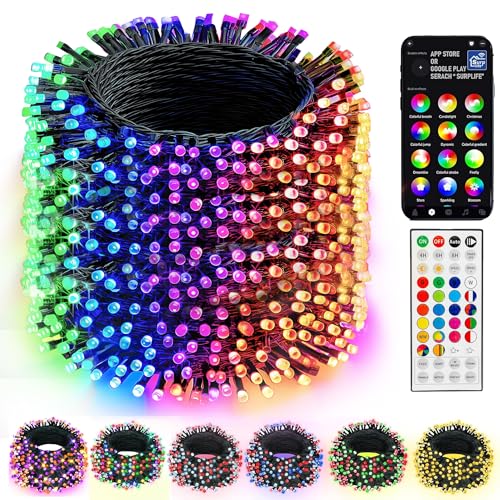
Programmable Color Changing LED Christmas Lights Outdoor: The Ultimate Buying Guide
Transform your home's exterior with smart, app-controlled holiday lighting. Learn how programmable RGB LED Christmas lights work, what to look for, and how to build a weatherproof display that dazzles every season.
Explore the GuideWhy programmable color changing LED Christmas lights outdoor matter: Traditional string lights give you one color and one look. Modern programmable RGB LEDs let you switch between warm white, festive reds and greens, or millions of custom colors — all from your phone. If you are researching before you buy, this guide covers the technology, the features that actually matter, and how to install a display that survives rain, snow, and wind.
Key Features to Compare Before You Buy
App & Smart Control
Most programmable sets pair with a mobile app over Wi-Fi or Bluetooth. Look for apps that support schedules, scenes, music sync, and group control so you can manage multiple strands at once.
Weatherproof Rating
Outdoor-rated lights should carry an IP65 or higher rating. The connectors, controller, and power adapter are the most vulnerable parts — check that each is sealed against moisture.
Color Range & Brightness
True RGB LEDs produce millions of colors. Better controllers offer per-LED addressing, smooth fades, and adjustable brightness rather than a fixed set of preset colors.
Expandability
If you plan to light a large yard, choose a system that supports daisy-chaining multiple strands and has a controller rated for the total length you need.
Power & Wiring
Low-voltage sets are safer and easier to extend. Confirm the adapter is outdoor-rated and that the total strand length stays within the controller's supported maximum.
Build Quality
Thicker wire gauges, UV-resistant insulation, and reinforced connectors last longer through winter weather. Entry-level sets often use thinner wire that degrades faster.
How Programmable Color Changing LED Lights Work
Programmable RGB LED Christmas lights use individually addressable light-emitting diodes. Each LED contains red, green, and blue chips that mix to create any color in the spectrum. A small controller sends data signals down the wire telling each LED which color and brightness to display. Because the controller manages every light independently, you can create chasing effects, gradients, color waves, and synchronized patterns that are impossible with traditional strands.
Most modern sets connect to your home network through Wi-Fi or Bluetooth. The companion app acts as the command center: you pick a scene, set a timer, or sync the lights to music. Some systems also integrate with voice assistants, letting you turn the display on or off hands-free. When you are ready to expand your outdoor setup, pair your lighting with complementary solar garden lights for pathways and garden beds, or explore outdoor lighting ideas to tie the whole façade together.
Entry-Level, Mid-Range, and Premium: Understanding Quality Tiers
Programmable outdoor Christmas lights fall into three broad quality tiers. Understanding the differences helps you match a system to your goals without over- or under-buying.
Entry-Level
Basic app control, a limited preset color palette, and shorter strand lengths. Suitable for small porches or a single hedge. These sets usually use thinner wire and simpler controllers, so they are best kept under cover or in mild climates.
Mid-Range
Full RGB color mixing, smoother effects, scheduling, and better weather sealing. This is the sweet spot for most homeowners lighting a roofline or front yard. Mid-range controllers typically support longer runs and more reliable Wi-Fi connectivity.
Premium
Per-LED addressing, music sync, advanced scene customization, and commercial-grade connectors. Premium systems are designed for large installations, complex animations, and harsh winter conditions. They usually offer the most robust app experience and the longest warranties.
As a rule of thumb, mid-range models usually offer noticeably smoother effects and more reliable app performance than entry-level sets, while premium systems add the flexibility and durability needed for elaborate, permanent installations.
Installation Tips for a Weatherproof Outdoor Display
Proper installation is what separates a display that lasts one season from one that survives year after year. Follow these steps:
- Plan your layout first. Measure the roofline, trees, and shrubs you want to light. Sketch the run so you know how many strands and extension cables you need before you climb a ladder.
- Protect the connections. Even IP65-rated connectors benefit from being wrapped with self-sealing silicone tape or positioned under an eave where water cannot pool.
- Keep the controller dry. Mount the controller and power adapter in a sheltered spot — under a porch, inside a weatherproof box, or in the garage — and run a low-voltage cable to the first strand.
- Use mounting clips, not staples. Plastic gutter clips and adhesive-backed hooks hold strands securely without piercing the insulation, which is a common cause of short circuits.
- Respect the maximum run length. Daisy-chaining beyond the controller's rated capacity causes voltage drop, dimming the far end of the display and stressing the power supply.
- Test before you mount. Plug in the full run on the ground to confirm every LED works and the app connects before you commit to a ladder-height installation.
If you are also refreshing the landscape around your display, consider adding ponds and fountains as a focal point, or browse retaining walls ideas to frame a sloped front yard. For pathways leading to the display, solar garden lights keep the walkway safe without extra wiring.
Quick Buying Checklist
Before you commit to a set of programmable color changing LED Christmas lights outdoor, run through this checklist:
- IP rating: IP65 or higher for anything exposed to rain or snow.
- Control type: Wi-Fi for whole-home control and voice assistants; Bluetooth for simple, local control.
- Strand length vs. run length: Confirm the total length the controller supports, not just the length of one strand.
- App quality: Read reviews about app stability, update frequency, and ease of scene creation.
- Expandability: Can you add more strands or controllers later without replacing the whole system?
- Warranty: A longer warranty usually signals better build quality and more confidence in weatherproofing.
Pairing your lighting upgrade with other outdoor improvements makes the investment go further. Explore outdoor living ideas to create a cohesive holiday atmosphere, or check landscaping guides for planting evergreens that look great lit or unlit.
Frequently Asked Questions
Can programmable LED Christmas lights stay outside all winter?
Yes, if they are rated IP65 or higher and the controller and power adapter are sheltered. Even weatherproof sets last longer when connectors are taped and the controller is mounted away from direct rain and snow.
Do I need Wi-Fi for color changing LED lights?
Not always. Bluetooth-controlled sets work without a home network, but Wi-Fi models offer remote access, scheduling, and voice assistant integration. Choose based on how much automation you want.
How many strands can I connect together?
It depends on the controller and power supply. Always check the manufacturer's maximum run length — exceeding it causes voltage drop and can damage the controller. Mid-range and premium systems typically support longer runs than entry-level sets.
Are RGB LED lights bright enough for roof lines?
Yes. Quality RGB LEDs are bright enough for rooflines and trees. Look for sets with adjustable brightness and per-LED control so you can tune the intensity to your façade.
What is the difference between preset scenes and per-LED control?
Preset scenes give you a fixed menu of colors and effects. Per-LED control lets you assign a color to each individual light, enabling gradients, chasing effects, and fully custom animations. Premium systems offer per-LED control; entry-level sets usually rely on presets.