Best Way to Get Rid of Weeds in Driveway: A Complete Guide
Discover proven methods to eliminate stubborn weeds from your driveway—whether it's asphalt, concrete, or gravel. Learn chemical, natural, and preventive strategies that keep your driveway clean year-round.
What's Inside This Guide
Why Weeds Thrive in Driveways (and Why They're So Hard to Kill)
Driveways are one of the most challenging places to control weeds. The narrow cracks between concrete slabs, the loose surface of gravel driveways, and the edges where pavement meets soil all create perfect micro-environments for weed seeds to germinate. Unlike a lawn, where grass competes with weeds for nutrients, a driveway offers bare, undisturbed spaces with plenty of sunlight and heat—ideal conditions for tough species like dandelions, crabgrass, and plantain.
The key challenge is that driveway weeds often develop deep taproots that can survive surface-level removal. Simply pulling the top off a dandelion or thistle leaves the root intact, and the weed regrows within weeks. That's why the best way to get rid of weeds in driveway areas combines multiple approaches: killing the root system, removing the plant completely, and then blocking future growth.
If your driveway is gravel rather than paved, the problem is compounded because weed seeds can settle throughout the entire surface. You'll want to read our dedicated guide on the best way to get rid of weeds in gravel driveway for surface-specific strategies.
Quick Tip: Weeds in driveway cracks are easiest to kill when they're young. Inspect your driveway every couple of weeks during growing season and treat small weeds before they establish deep roots.
Manual Removal: The Foundation of Any Weed Control Plan
Before reaching for chemicals or natural sprays, start with physical removal. Manual methods are especially effective for small infestations and for weeds growing in cracks where you can access the root. Here are the most effective tools and techniques:
1. Crack Weeder & Hand Weeding Tools Essential
A crack weeder—sometimes called a crevice weeder or paver weeder—has a thin, angled blade designed to slip between concrete slabs and pry out weeds with their roots. This is the single most effective hand tool for driveway cracks.
- Best for: Dandelions, plantain, thistle, and other taproot weeds in narrow cracks
- Technique: Insert the blade alongside the weed, lever it upward to loosen the root, then pull the entire plant out
- Timing: Best done when soil is slightly moist, making roots easier to extract
2. Pressure Washer Mid-range
A pressure washer blasts away weeds, dirt, and debris from cracks and gravel surfaces. It's particularly effective on gravel driveways where weeds grow throughout the surface. Use a narrow nozzle and work along the cracks at a moderate angle.
- Best for: Gravel driveways, large cracks, and clearing debris that harbors seeds
- Caution: Too much pressure can damage asphalt or loosen concrete; test on a small area first
- Pair with: A garden hose suited for a pressure washer to ensure adequate water flow
3. Boiling Water Budget-friendly
Pouring boiling water directly onto weeds in cracks is a simple, chemical-free method that scalds plant tissue and roots. It's most effective on young weeds and small patches.
- Best for: Small weeds in concrete or asphalt cracks
- Limitation: May require repeat applications for established weeds; not practical for large areas
- Safety: Use a kettle with a spout for precise pouring and wear closed-toe shoes
Manual removal alone won't keep a driveway weed-free permanently, but it's the essential first step. Once the existing weeds are gone, you can apply a preventive treatment or physical barrier to stop new growth. For a broader look at removing weeds from hardscape surfaces, see our guide on the best way to get rid of weeds between patio stones.
Chemical Weed Control: Fast, Effective, and Targeted
When manual removal isn't enough—especially for large driveways or severe infestations—herbicides offer a reliable solution. The key is choosing the right product and applying it carefully to avoid damage to surrounding grass and plants.
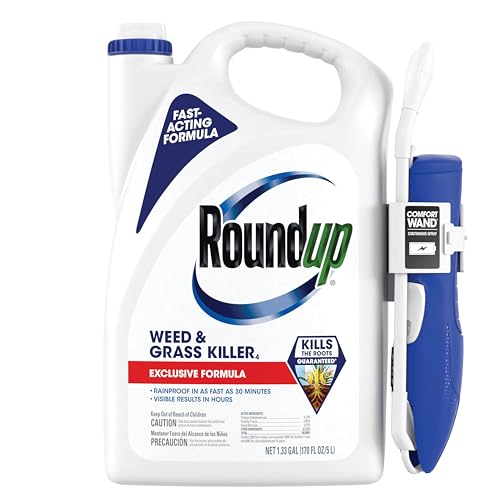
Non-Selective Herbicides (Glyphosate-Based) Premium
Non-selective herbicides kill any plant they contact, making them ideal for driveway cracks and gravel surfaces where you want total weed elimination. Glyphosate is the most common active ingredient; it's absorbed through the leaves and travels to the roots, killing the entire plant.
- Best for: Dandelions, thistle, bindweed, and other deep-rooted perennial weeds
- Application: Spray on a calm, dry day when rain isn't expected for at least 24 hours
- Precaution: Protect nearby grass and garden beds with cardboard or plastic sheeting during application
Selective Herbicides Mid-tier
Selective herbicides kill broadleaf weeds while leaving grass intact. They're useful along driveway edges where you want to preserve the lawn but eliminate weeds encroaching from the pavement.
- Best for: Driveway edges bordering lawns
- Note: Not suitable for cracks in the middle of a driveway where no grass exists—non-selective products are more appropriate there
Weed & Feed Products Convenience
Combination weed-and-feed products simplify lawn maintenance along driveway edges, but they're not designed for bare pavement. For lawn-adjacent weed control, you might explore a liquid weed and feed concentrate for sprayers that covers both fertilization and broadleaf weed control in one pass.
Important: Always read and follow the label instructions on any herbicide. Wear gloves, eye protection, and long sleeves during application. Keep children and pets away from treated areas until the product has dried completely.
Natural & Organic Solutions for Driveway Weeds
If you prefer to avoid synthetic chemicals—especially around pets, children, or storm drains—natural solutions can be highly effective when applied correctly. Here are the most proven options:
Horticultural Vinegar (20% Acetic Acid) Affordable
Regular household vinegar (5% acetic acid) weakens weeds but rarely kills them. Horticultural vinegar, which contains 20% acetic acid, burns down weed tops on contact and can kill young weeds outright. It works best on sunny days when the weed is actively growing.
- Best for: Small weeds, moss, and young seedlings in cracks
- Limitation: May not kill deep taproots; repeat applications are often needed
- Safety: Horticultural vinegar is corrosive—wear gloves and eye protection
Salt, Vinegar & Dish Soap Solution Budget-friendly
A homemade mix of one gallon of white vinegar, one cup of table salt, and a tablespoon of dish soap is a popular DIY weed killer for driveways. The salt draws moisture from the plant, the vinegar burns the foliage, and the soap helps the solution adhere to waxy leaves.
- Best for: Cracks and gravel driveways where no desirable plants grow nearby
- Caution: Salt can accumulate in soil and harm nearby plants or grass—avoid using near garden beds or lawn edges
Flame Weeder (Propane Torch) Mid-range
A flame weeder uses a propane torch to heat weed cells until they burst, killing the plant without chemicals. It's fast, satisfying, and effective on young weeds in cracks and gravel.
- Best for: Gravel driveways and large cracks where you can move quickly
- Safety: Never use near dry vegetation, wooden structures, or gas lines; keep a hose or extinguisher nearby
For more natural options that won't harm grass, see our article on the best natural weed killer that won't kill grass. If your driveway borders a lawn, be careful with salt-based solutions—they can leach into the soil and damage turf over time.
Weed Control for Gravel Driveways: Special Considerations
Gravel driveways present a unique challenge because weeds can sprout anywhere across the surface, not just in cracks. Loose gravel also makes pulling weeds difficult because the surface shifts underfoot. Here's how to approach gravel driveway weed control:
- Start with a hard rake: Rake the gravel to disturb weed seedlings before they establish. Regular raking disrupts the seed-to-soil contact that weeds need to germinate.
- Apply a pre-emergent herbicide: Pre-emergent products create a chemical barrier that stops weed seeds from sprouting. Apply in early spring before weed seeds germinate.
- Use a weed barrier fabric: If you're installing or renovating a gravel driveway, lay a woven landscape fabric beneath the gravel. This blocks weeds from growing up through the surface while allowing water to drain.
- Consider polymeric sand for edges: On the edges of gravel driveways where gravel meets pavement or lawn, polymeric sand can lock the border and prevent weeds from encroaching.
For a deeper dive into gravel-specific strategies, including the best way to kill grass and weeds in gravel driveway, see our dedicated guide. If you're dealing with weeds in driveway cracks on a paved surface, our article on the best way to get rid of weeds in driveway cracks covers crack-specific techniques in detail.
Preventing Weeds from Coming Back: Long-Term Driveway Maintenance
Killing existing weeds is only half the battle. To keep your driveway weed-free, you need to address the conditions that allow weeds to grow in the first place. Here's a step-by-step prevention plan:
1. Seal Cracks and Joints
Inspect your driveway every spring and fall for new cracks or widening joints. Fill them with a flexible concrete crack filler or polymeric sand. Polymeric sand is especially effective for paver driveways and wide joints because it hardens when wet, creating a durable barrier that weeds can't penetrate.
2. Apply a Pre-Emergent Herbicide
In early spring, apply a granular pre-emergent herbicide to driveway cracks and gravel surfaces. This creates a chemical barrier that prevents weed seeds from germinating. Reapply according to the product label—typically every 3-4 months during the growing season.
3. Keep the Driveway Clean
Weed seeds travel on wind, water, and shoes. Regularly sweep or blow debris—leaves, grass clippings, and soil—off the driveway. This removes the organic matter that weed seeds need to sprout. A quick sweep once a week during growing season makes a noticeable difference.
4. Maintain Edges and Borders
Weeds often invade from the edges where pavement meets soil. Install a physical edging material—steel, aluminum, or plastic—along driveway borders to create a barrier. Keep grass and garden beds trimmed back from the pavement edge so weeds can't flop over and root in cracks.
5. Consider a Weed Barrier for Gravel
If you have a gravel driveway, a heavy-duty woven landscape fabric beneath the gravel is the most effective long-term weed prevention. It blocks light and prevents seeds from reaching soil while allowing water to drain. For existing gravel driveways, you can sometimes retrofit a barrier by removing the top layer of gravel, laying fabric, and replacing the gravel.
Pro Tip: After pulling weeds from cracks, pour a small amount of polymeric sand or concrete filler into the crack and mist it with water. This seals the space and prevents new weeds from taking hold.
Method Comparison: Which Weed Control Approach Is Right for You?
Use this table to compare the most common driveway weed control methods at a glance. The best approach often combines two or three methods—for example, manual removal followed by a pre-emergent treatment.
| Method | Best For | Effort Level | Speed | Longevity | Cost Tier |
|---|---|---|---|---|---|
| Crack weeder / hand pulling | Small infestations, taproot weeds | Moderate | Slow | Short-term | Entry-level |
| Pressure washer | Gravel driveways, large cracks | Moderate | Fast | Short-term | Mid-range |
| Boiling water | Small cracks, chemical-free | Low | Slow | Short-term | Budget-friendly |
| Non-selective herbicide | Deep-rooted weeds, large areas | Low | Fast | Medium-term | Mid-tier to Premium |
| Horticultural vinegar | Young weeds, organic preference | Low | Medium | Short-term | Affordable |
| Salt/vinegar/soap mix | Cracks away from desirable plants | Low | Medium | Medium-term | Budget-friendly |
| Flame weeder | Gravel, large cracks | Moderate | Fast | Short-term | Mid-range |
| Pre-emergent herbicide | Prevention, all driveway types | Low | N/A (preventive) | Long-term | Mid-tier |
| Polymeric sand / crack filler | Sealing cracks and joints | Moderate | N/A (preventive) | Long-term | Mid-range |
Frequently Asked Questions About Driveway Weed Control
Take Control of Your Driveway Today
You don't need to live with unsightly weeds. Whether you choose manual removal, a targeted herbicide, or a natural solution, consistency is the key to a clean, weed-free driveway. Start with the method that suits your situation, and make weed control part of your seasonal maintenance routine.
Back to Top